Loading...
Punakha
Khamsum Yulley Namgyal Chorten
ReflectionSpiritualitySolitudeCalm
You cross a small suspension bridge over the river and the path begins. Rice terraces on both sides, farmers bending in shin-deep water, the sound of irrigation channels and birdsong and nothing else. The temple is ahead of you, somewhere above, but you cannot see it yet. The walk is the first gift.
Forty-five minutes uphill through working farmland. Not wilderness. Not spectacle. Someone's livelihood, laid out in green terraces that step up the hillside like a staircase designed by patience. You pass a farmhouse where a dog sleeps in the sun. You pass a field where a woman is planting. She looks up. She waves. You wave back. That is the entire social contract of this walk.
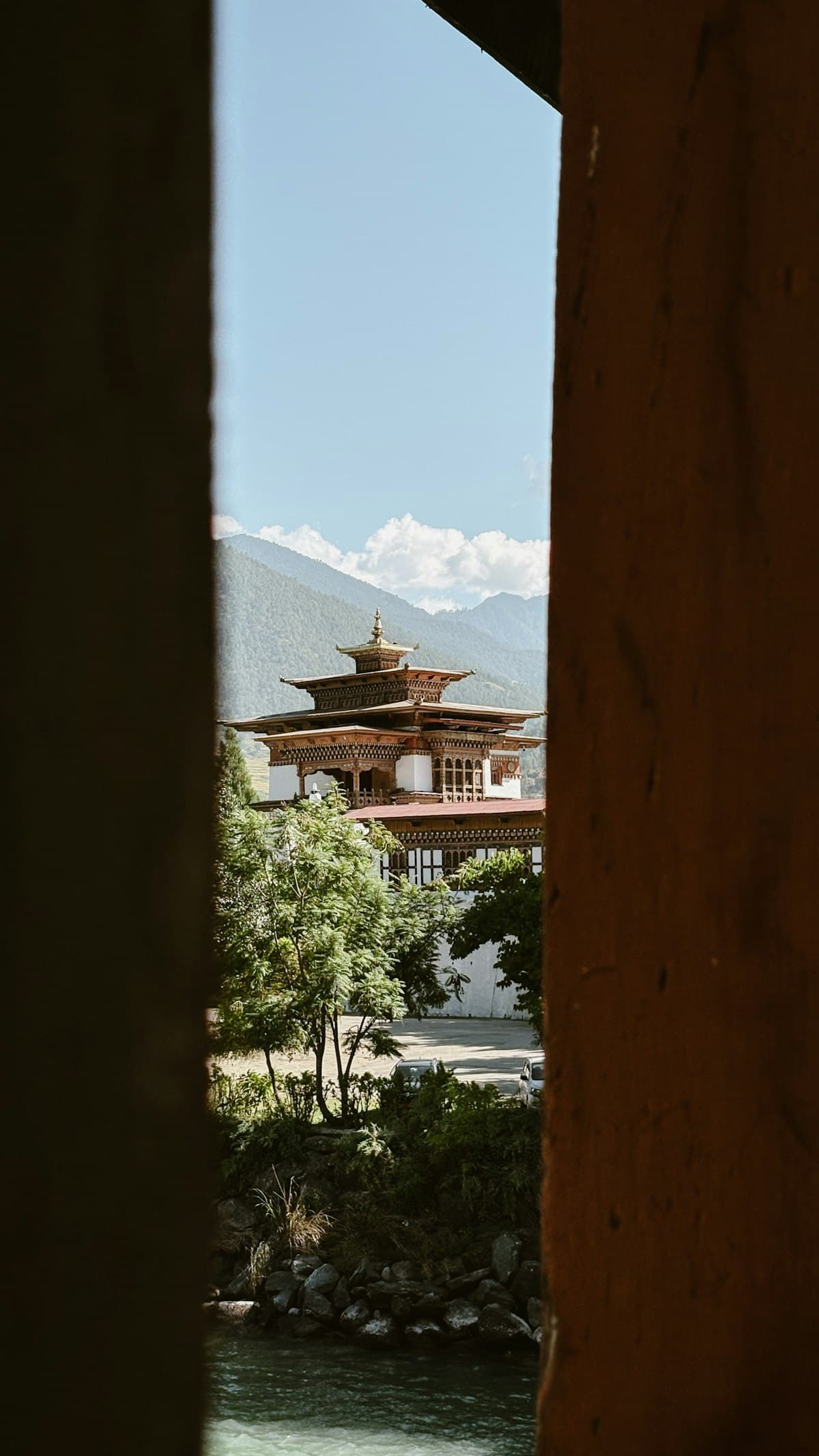
The temple appears when the trees thin. It is small — three storeys, ornate, perched on a hilltop as though it had grown there rather than been built. The Khamsum Yulley Namgyal Chorten was commissioned by the Queen Mother and took nine years to complete. Every surface inside is painted with murals of extraordinary detail — wrathful deities, guardian figures, celestial beings, all rendered with the kind of precision that suggests the artists understood their work as prayer.
From the top floor, the Punakha Valley opens below you. The river bends through green. The terraces descend. The mountains hold the horizon. Very few people are here. The silence is not emptiness — it is fullness with the volume turned down. You came here on foot, through someone else's farmland, and the reward is a small, perfect temple and a view that asks for nothing except your attention.
Sensory Profile
Noise Level
Crowd Level
Brightnessbright on the walk (open terraces), dim inside the temple
Temperaturewarm on the walk (low-altitude Punakha Valley), cool inside the stone temple
SmellsRice paddies, wet earth, wildflowers on the path, incense inside the temple, warm grass
Unexpected SoundsWater in irrigation channels. Birdsong — varied and constant. Wind through the rice terraces. Occasionally a farmer calling.
Walking Difficultymoderate
Social ExpectationsRemove shoes inside the temple. The caretaker monk may offer a brief explanation. Silence is natural here — nobody needs to enforce it.
Quiet SpacesYes
Best Time (Low Stimulation)Any time. This place is almost always quiet. Morning light is beautiful on the terraces. Afternoon light is warm at the temple.
Sensory data informed by clinical neurodevelopmental expertise.

Mindfulness Activity
The Temple Nobody Rushes To
Four prompts along the walk to Khamsum Yulley Namgyal Chorten — from the suspension bridge to the hilltop temple overlooking the Punakha Valley.
Grounding and sensory. A way in.
- 1
The Bridge
A small suspension bridge over the river marks the beginning. Below, the water has come from the mountains and is going to the valley.
As you stand on the suspension bridge before crossing, looking down at the river.
Watch the water moving beneath you. Notice whether it moves faster in the centre or at the edges. Now notice your own breathing. Is it moving fast or slow right now? You do not need to change it. Just notice.
- 2
The Terraces
The walk climbs through working rice terraces where farmers bend in shin-deep water and irrigation channels carry sound.
While walking through the rice terraces, surrounded by the sounds of water and farmwork.
Look at the nearest terrace. Notice the colour of the water, the shape of the plants, the angle of the hillside. Find one sound that is not your footsteps. Let that sound be the only thing you listen to for thirty seconds.
- 3
The Murals
Inside the temple, every surface is painted with wrathful deities, guardian figures, and celestial beings rendered with extraordinary precision.
Standing inside the temple, choosing one figure from the murals to study.
Choose one painted figure. Look at the colours first, then the expression, then the hands. Someone spent weeks painting this single figure. Let your eyes rest on one detail and stay there for a full minute.
- 4
The Summit
From the top floor, the entire Punakha Valley opens below. The river bends through green. The mountains hold the horizon. Very few people are here.
Standing on the top floor of the temple, looking out at the valley below.
Look at the valley without naming what you see. No labels. No photographs. Just shapes, colours, and distances. Let your eyes soften and take in the whole view at once. What does your body feel like when you stop cataloguing?
For Curious Minds
Khamsum Yulley is perfect for an ADHD mind that is tired of big experiences and wants something quietly extraordinary. The walk provides movement and changing scenery — terraces, farmhouses, forest, hilltop. The temple provides surprise — its interior is among the most intricately decorated in Bhutan. And the solitude provides something the ADHD mind rarely gets: the experience of having a beautiful place essentially to yourself.
- •Terrace Counting: As you walk through the rice paddies, count the individual terraces you pass. Each one is a hand-built level. How many terraces does it take to climb from the river to the hilltop? The number is astonishing.
- •Farm Life Observation: On the walk, find five signs of daily life — a tool leaning against a wall, a dog, a cooking fire, drying chillies, a child's toy. The walk passes through a working landscape, not a preserved one. Everything you see is in use.
- •Mural Detail Hunt: Inside the temple, the murals are extraordinarily dense. Find the most unusual figure. Find the smallest detail. Find a hidden animal. The artists packed meaning into every centimetre, and the ADHD eye that loves finding things others miss is exactly the right tool for this temple.
- •Valley Photography from Height: From the top floor, the valley stretches in every direction. Take photographs facing each cardinal direction. The landscape changes completely depending on where you look. Four photographs, four different worlds.
- •Speed Descent: Walk down faster than you walked up. The terraces invite it — the downhill path through the paddies is easy and the changing angle shows you everything you missed on the way up. New details appear when the direction reverses.
Regulation Suggestion
If the walk feels too long or too slow, increase your pace on the uphill sections — the physical effort will engage your body and focus your attention. If the temple interior feels too dim or small, step outside to the viewing platform and let the wide valley view reset your visual system. The walk down is easier and faster and provides natural decompression.